What is coworking? Definition and everything you need to know

For me, Carlos Llerena, one of the founders of The Shed Coworking, a coworking space is "a living work space". In it, there are specific areas with everything that is needed to carry out the work activity, such as rooms and offices, but also places to rest. In this way, the user can benefit from personalized support and a multidisciplinary community of coworkers, both independent and from small and medium-sized companies, who offer projects, business ideas, services and contact agendas.
| YOU MAY BE INTERESTED IN |
|---|
| 1. Office and Coffee" is back: your coworking in the open air. |
| 2. The best workplaces for digital nomads. |
| 3. Best coffee shops in the Salamanca neighborhood |
This flexible way of working and entrepreneurship has exploded in recent years. According to Statista projections, there will be some 41,975 coworking spaces in the world by the end of 2024. Just Google coworking Madrid or coworking spaces in Madrid and you will get hundreds of results.
It is not surprising, seeing how entrepreneurs and teleworkers from SMEs and large companies are opting for these flexible places. All of them are attracted to develop their projects, away from traditional offices and business centers, in a community where they can establish relationships with other people.
The philosophy of these spaces is also reaching some business giants. They do not move to other offices, as they have their own, but they have adopted coworking concepts such as transversality between teams.
"What is the origin of coworking?
The truth is that it is not clear where and when the first coworking was born. Some place it in Germany, others in the United States.
The first ones claim that this movement started in Berlin in 1995. One of the first hackerspaces in the world was founded there, physical spaces where people went to work and interact with each other.
In 1999, the man we consider "the father" of coworking spaces appeared in New York: Bernie Dekoven. He was the one who convinced us that it was possible to carry out collaborative work and business ventures, supported by computers and new technologies, for personal benefit, but also for the common good.
Their ideas began to gain popularity and began to spread, thanks to the support of other professionals seeking to have such places to work.
In 2006, engineer, entrepreneur and software developer Brad Neuberg created what is considered the world's first coworking space in San Francisco. It was called Hat Factory and started with just three freelancers, until it became what it is today: the Citizen Space in San Francisco. From there, the word coworking took off like wildfire.
Worldwide, there are currently some 41,975 coworking spaces, according to figures from Statista. Spain, as reflected in Coworking Spain data, has become one of the protagonists of this boom as it is the second best country to work remotely. Among the factors in its favor are: the speed of the Internet, the large number of coworking spaces and visas for freelancers.
The latest report on the State of Coworking in Spain shows that the sector continues to grow nationally with 1036 spaces. The provinces with the highest number of coworking centers are: Barcelona (468), Madrid (391) and Valencia (147). The remaining spaces are spread throughout the rest of Spain, with Malaga (72), Seville (61), Alicante (40), the Balearic Islands (41) and Las Palmas (49) at the top of the ranking.
The figures invite optimism since, according to the consulting firm Savills Aguirre Newman, it is estimated that coworking will account for 30% of the national office supply by 2030.
"What coworking offers
In addition to providing air-conditioned spaces and rooms with excellent internet connectivity (wifi and structured cabling), these spaces must provide building-as-a-service solutions for professionals, SMEs and companies from all sectors.
In addition to these aspects, studies on trends in the sector speak of new requirements such as those pointed out by the real estate multinational Inmocolonial:
- Uniqueness of spaces with special emphasis on unique interior design styles.
- Importance of sustainability and presence of green spaces in the office.
- Integration of leisure and work spaces.
- Connection with other services outside the coworking (gyms, public transportation, libraries, restaurants, etc.).
- Inclusion of technological solutions to facilitate space management. These include the installation of facial recognition systems for users, the implementation of voice assistants, both in operational areas and in rest areas, the addition of management software for more efficient work performance, and the implementation of artificial intelligence technologies.
- Creation of non-niche communities where companies and professionals from very different disciplines can be integrated in a flexible way and where synergies can arise.

All this joint effort is designed to achieve one of the main keys of coworking: to facilitate the remote work of users and multiply the opportunities for them to collaborate on joint projects. To this end, activities can be organized to promote networking, training on various topics or to give visibility to each client and their business through the center's digital communication channels.
The objective is always the same: to generate a social, entrepreneurial and professional community that is dynamic and adapts to the needs of each coworker. The options are flexible and varied, as everyone can choose the center according to their circumstances: from the budget they have, if they want to work more or less far away from the center, the activities they are interested in, the number of people they are responsible for, if they need offices or flexible positions, etc.
The concept of coworking and the profile of its users have continued to evolve, with a variety of options for using shared workspaces. The entry of companies and small and medium-sized enterprises (SMEs) as users has led to an increase in demand for dedicated workstations and private offices, according to data from Vía Lab.
The reasons why many companies have decided to move to coworking spaces are varied. On the one hand, it is a more economical option because they do not have to pay the costs of a traditional office. On the other hand, they offer their teleworkers a place where they can work and socialize.

Flexible workstations are more attractive to sporadic coworkers, such as digital nomads, or to workers whose companies have adopted less traditional trends, such as the hybrid workday or hot desking, a system in which employees use available desks at different times on a first-come, first-served basis.
Coworking companies are constantly innovating to cater to this wide variety of tenants. Nowadays, you can even find coworking spaces in airports. For example, Dallas-Fort Worth International Airport's Terminal C, Spaces at Brussels Airport or Adolfo Suárez Madrid-Barajas Airport offers meeting rooms.
"Advantages of coworking
Coworking for professionals
For company employees and freelancers there are some advantages of coworking that make a difference:
- They may be in contact with different professionals who have nothing to do with their work activity. Each person decides who to talk to, what to talk about and what to share.
- Working in a coworking space can improve the image of your business, whether you are a start-up or a freelancer. You can work with customers or suppliers in a professional working environment and even receive them in the many meeting rooms and offices available in these collaborative spaces.
- With so many different services, if someday the company grows, coworking can offer different options, whether it is more workstations or an office according to the needs of each person.
- Working in a coworking space increases productivity. The prevailing atmosphere and activity helps to get down to work and facilitates the separation between work and family life.

2. Coworking for companies
A recent Harvard Business Review survey of 819 respondents on the effects of coworking found that most find it more satisfying to work in a shared workplace. The main reason is the flexibility, both in terms of space and coworking, that employees find in coworking spaces.
Coworking sites allow employees to "relationally design their jobs," explains the Harvard Business Review study. That is, they build relationships beyond the company's employees and generate connections with other types of professionals during the workday. This change in approach has been associated with positive results, including increased employee satisfaction, performance and retention.
Among the advantages reported by workers in this survey were:
- Avoid unnecessary interactions with other colleagues.
- Enjoy the diversity of activities, events and professionals that make up the coworking ecosystem.
- Take a break from the competitiveness that may exist in the company by interacting with professionals from outside the company.
- Feeling part of a community.
- Have opportunities to learn and socialize.
In other research on this topic, Harvard Business Review has found that people who use coworking spaces get more meaningful work done, with more control, and have an unprecedented sense of community.
The culture is conducive to organic collaboration with other coworkers. In addition, it is appreciated that the spaces are flexible, both in terms of management and cost savings, as excessively long leases are not required.
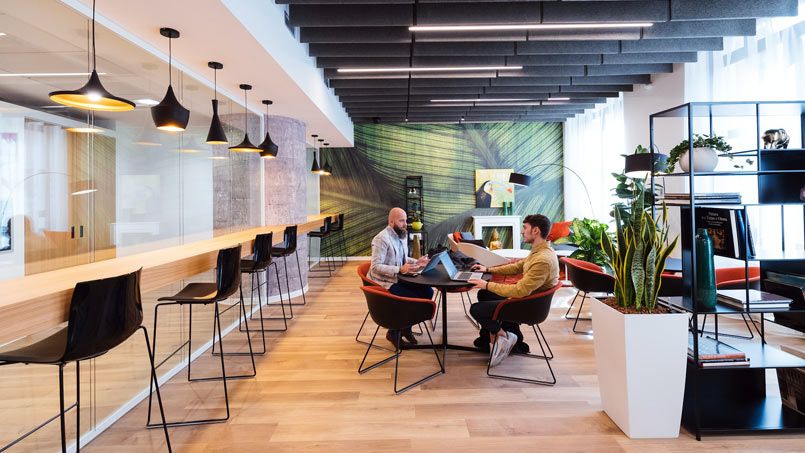
Therefore, startups and SMEs can access affordable and flexible locations, while larger organizations find greater encouragement for innovation in their workplaces. It is true that some companies tend to have similar office spaces, but they may lack a culture that promotes this flexibility of collaborations between different departments.
"What are the best examples of coworking?
When choosing a coworking space, it is always important to take into account the location of the space. Sometimes, it is a determining factor when it comes to choosing one or another. At The Shed Coworking we are aware of this and, for this reason, we offer an unbeatable location in Madrid in the emblematic Salamanca neighborhood of the capital, one of the most popular in Spain.
And that's not all! Other important factors at The Shed Co are networking, creating synergies and having fun while working. For this reason, we organize different events in Madrid throughout the month, such as our representative breakfast, the thematic aperitif or the tapa of the day, an event where all coworkers have a beer with their pintxo.
Despite this, there is an increasing trend towards rural coworking that can allow you, for example, to spend the summer season in a relaxed and pleasant environment.
"How coworking works
Coworking spaces offer different work options. Basically, they usually propose three modalities.
1. Flexible position
You, your laptop and a table. No strings attached.
If you need a space to concentrate and be more productive, all you have to do is bring your laptop and choose a place in the common area of the coworking enabled for it. The flexible workstation allows access to the facilities during a typical workday.
It is perfect for: digital nomads, freelancers, remote workers, students and the curious.
2. Fixed position
Your private space in a shared room.
The fixed workstation combines the comfort of a home office with the efficiency and convenience of coworking. If maximum concentration is required, just put on headphones to work undisturbed. If a more intimate environment is required, a private meeting room is available. And if you prefer to have a coffee and a chat, you can meet your colleagues in the kitchen.
It is perfect for: freelancers, investors, remote workers, IT service providers, entrepreneurs and bold freelancers.
3. Private office
Private office adapted to your needs.
Private coworking office and separate from the rest of the coworking that allows us to maintain privacy while remaining an active member of the community.
It is perfect for: startups, companies with a long history, investment funds, delegations of large corporations, IT service providers.
"Services offered by a coworking facility
- Access to fully equipped work areas with flexible schedules.
- Rental of meeting rooms with audiovisual equipment (screens, webcam, projector, etc.).
- Common areas (kitchen, living rooms, terrace).
- Workshops, lectures, events, snacks, breakfasts, etc.
- Corporate, fiscal and administrative domicile.
- High-speed wired Internet.
- Coffee and tea.
- Wifi.
- Lockers and storage.
- Printing and reprographic services.

Regarding the doubts that may arise about certain details of these services, we recommend an excellent article published by Inarquia where we explain in detail what coworking is and how the day-to-day work in a coworking space works.
"Who live in these coworking spaces, who are the coworkers?
The profile of the coworker is usually a young person, with higher education, who works in new technologies for a company. In addition, they live near the coworking center and are very satisfied with their workspace.
According to data from the employment platform, Zippia, the average age of coworking users is usually 36 years old. In these spaces, the different age groups are usually distributed in various professions. The older members usually work in the consulting field (which makes sense, as they are experienced professionals), and the younger ones are usually in sectors such as public relations, marketing or design. There are typically more men (60%) than women (40%) and corporate employees tend to be in the majority (58%) compared to freelancers (42%).


AUTHOR: CARLOS LLERENA
IT executive, entrepreneur, communicator and academic with international trajectory, expert in technology, marketing, project management and complex problem solving.
 Contents