Event venues by the hour vs. by the day in Madrid: when is it worth it (with real examples)
If you are looking for event venues by the hour in Madrid or are considering renting a venue by the day in Madrid, the question is not usually just about cost.
The real question is: Which format gives you more control, less stress, and better results?
Because booking a room is one thing. But ensuring that the event runs smoothly is quite another: that people arrive without chaos, that the setup is clear, that the audiovisual equipment doesn't fail, and that you don't end up paying more because you didn't plan the timing properly.
The good news is that this decision is usually quite simple when you look at the actual use of the space.
1) Signs for "by the hour" vs. "by the day"
A simple rule that usually works very well:
If your event has a fixed duration and little time for setup, it usually pays to rent by the hour.
If you are going to occupy half a long day or a full day, it usually makes more sense to consider a daily rental.
It usually compensates by the hour if:
- You have a meeting, committee, or presentation with a fairly set schedule.
- The event lasts between 2 and 4 hours.
- Assembly is simple.
- You don't need too many supplier inputs and outputs.
- The important thing is to handle the key moment well, without wasting time.
It usually pays per day if:
- You have several phases in the same event.
- There is calm pre-assembly and post-assembly cleanup.
- Speakers, catering staff, guests, and technical equipment arrive at different times.
- You need to use the space as a "base of operations."
- It is more expensive to add up overtime hours than to block the entire day.
To put it more clearly:
if you pay by the hour, you buy precision; if you pay by the day, you buy margin.
And when an event has many parts, the margin is worth a lot.
2) Typical examples
To see this more clearly, let's look at three very common cases.
2–3 hour steering committee meeting
This is the clearest case of hourly rental.
If you have an executive meeting, a decision-making session, or a meeting with clients where everything is fairly limited, you will not normally need to block off the entire space.
The important thing here is usually:
- Punctuality
- Privacy
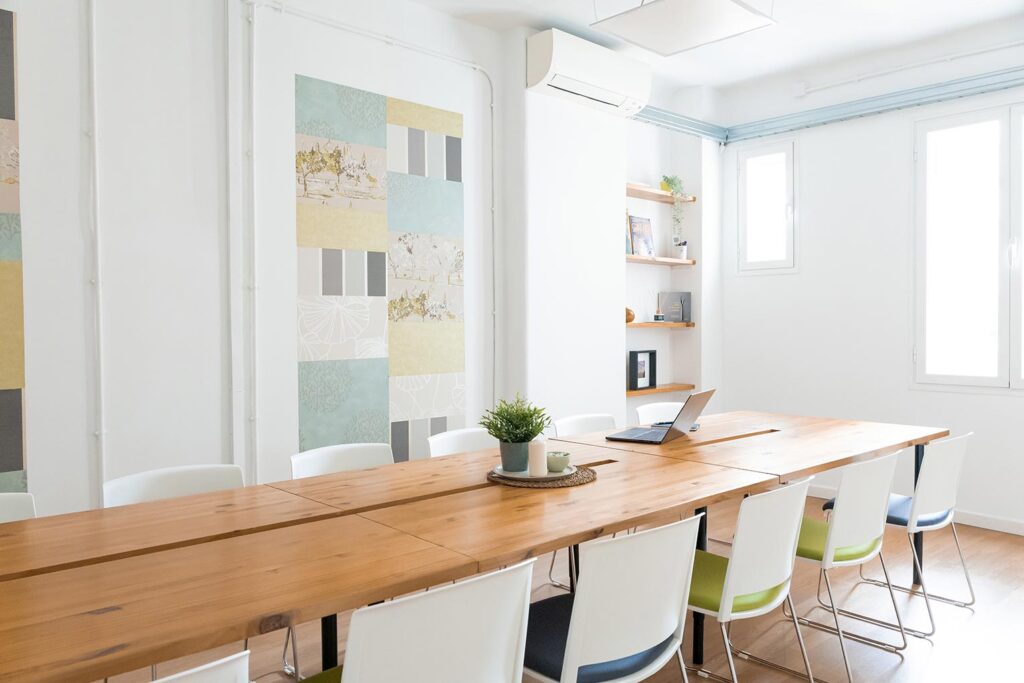
- Nice table and chairs
- Stable connectivity
- Make sure everything is ready when you arrive.
In this format, paying per day is usually unnecessary unless you want to arrive very early or extend your day with other meetings.
Conclusion: usually, by the hour.
5-hour presentation
Here we enter the intermediate zone.
Five hours is not "a little while," but it doesn't always justify a full day either. The key lies in one question:
Are those five hours really five... or will it actually be seven or eight with setup, testing, reception, and closing?
For example:
- If you have 45 minutes to assemble it
- Staggered arrival of attendees
- Presentation
- Questions
- Coffee break
- Networking
- Final collection
...then that event no longer occupies only the central block.
In that case, it's best to do the math honestly. Sometimes the hourly rate seems better at first, but once you add in the time before and after, the daily rental starts to make sense.
Conclusion: it depends, but many presentations of this type are on the borderline between hourly and daily rates.
Full day
If you are going to hold a training session, a long workshop, a recording, back-to-back meetings, or an event that lasts practically the entire working day, the answer here is usually simple.
The most common practice is to compensate on a daily basis.
Why? Because it allows you to work better:
- Without checking the clock every few minutes
- Without cutting useful breaks
- Without rushing the assembly
- Without the typical stress of "we're running out of time."
At these types of events, paying by the hour can work out well... until the extensions start.
Conclusion: normally, per day.
3) What does a professional space include?
Here is a very common mistake: comparing only square footage, photos, or price.
But at corporate events, what really makes the difference isn't just the room. It's what prevents problems.
A professional space should help you with at least three things:
Reception
Make sure attendees arrive and know where to go.
It seems basic, but when this fails, the event gets off to a bad start, even if the venue is beautiful.
AV resolved
Screen, projector, sound system, adapters, video call capability if needed... and, above all, make sure you don't have to improvise at the last minute.
Reliable connectivity
Stable WiFi. And if the event is important, it's even better if there is a more robust connection option to avoid any surprises.
When comparing rooms, don't just compare "space."
Compare this:
- Can you help me make everything run smoothly?
- Is there real support?
- Am I going to have to chase someone down to get the basics sorted out?
- Will the event look professional without overburdening my team?
Because, in the end, that is also a cost. It just doesn't always appear in the budget.
4) Advance access and setup: mandatory question
This is the question that many people forget... and then pay for.
Can I come in early to set up?
Always do it.
Even if your event lasts 3 hours, you may need:
- Arrive 30–45 minutes early
- Leave material
- Conduct a technical test
- Prepare documentation
- Moving furniture
- Coordinate the arrival of catering.
And that completely changes the comparison between hours and days.
Hourly rentals can still be worthwhile, yes. But only if that prior access is taken into account and does not turn a "short" reservation into a string of extra hours.
The smart way to request a quote is not to simply ask, "How much does it cost?"
Instead, ask:
- Actual duration of the event
- Assembly time
- Prior access
- Pickup time
- Technical requirements
- Whether there will be suppliers or guests arriving early.
In many cases, the right decision comes naturally when you look at the entire game and not just the middle innings.
5) Brief template
If you want to quickly calculate what's best for you, send us this brief. It saves you several trips back and forth and makes the quote much more accurate.
Quick brief to request a room
- Date of the event
- Actual hours of use
- Pre-assembly access time
- Estimated number of attendees
- Type of event
, etc.)
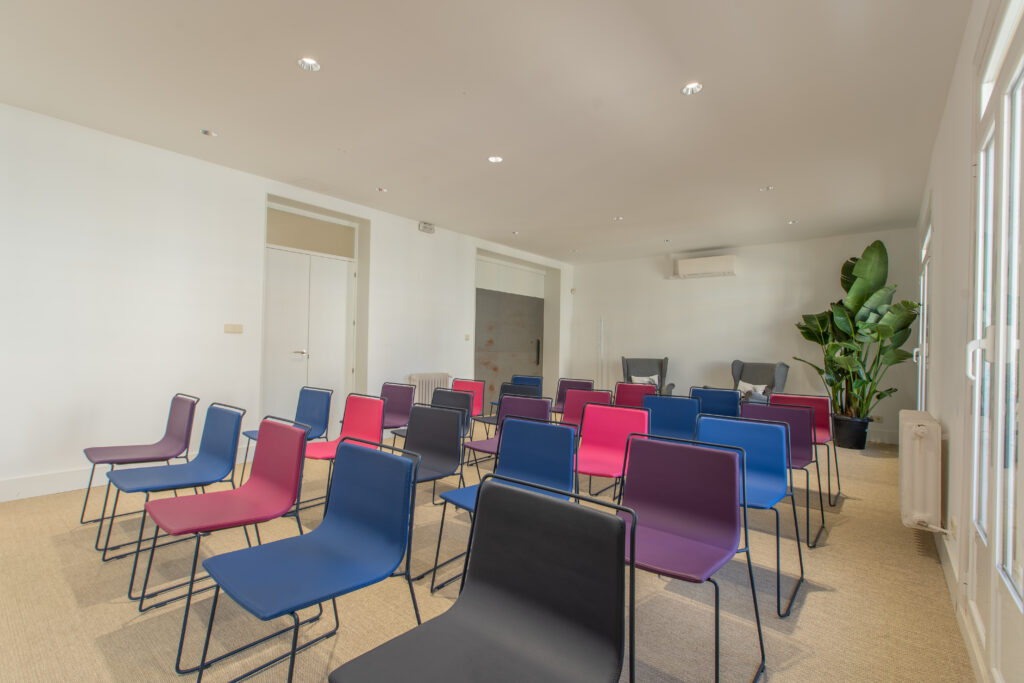
-type mounting (auditorium, school, U-shape, mixed)- AV requirements
- Reception of attendees
(yes/no) - Coffee break or catering
(yes/no) - Scheduled closing time and pickup
And if you want to make it even clearer, add this sentence:
"We want to know whether it is more cost-effective to book by the hour or by the day, taking into account setup, early access, and closing time."
With that, you're already comparing well.
So when does each option pay off?
To summarize:
- By the hour: when the event is short, controlled, and requires little setup.
- Per day: when you need leeway, multiple phases, or a really long day.
The best choice is not the one that "seems cheapest" at first.
It is the one that avoids improvisation, cost overruns, and unnecessary stress.
Because at a professional event, it's not just about paying less.
The important thing is that everything goes smoothly.
Calculate your option in 60 seconds
If you already have a date or an approximate idea, write to us and we will tell you what is most beneficial for you based on your specific case:
If you need an outdoor venue, starting in April you can check out our terraces for events.
Frequently Asked Questions
When is it worth renting an event room by the hour in Madrid?
This is a good option when the event has a fixed duration, usually between 2 and 4 hours, with little setup and no need to block off the space for the entire day. It is a common choice for committees, meetings, or short presentations.
When is it best to rent a room by the day in Madrid?
It usually works better when the event includes prior setup, several phases, breaks, suppliers, or long-term use of the space. For full-day conferences, training sessions, or events with operational leeway, booking by the day is usually more convenient and avoids last-minute extensions.
What else should be considered besides the price of the room?
In addition to price, it is important to consider actual usage time, prior access for setup, collection, reception of attendees, audiovisual equipment, and connectivity. A seemingly cheaper quote may not be worth it if you need extra hours.
Is it important to ask about prior access?
Yes. This is one of the most important questions. Even if the event only lasts a few hours, you may need to arrive earlier to set up, carry out technical tests, or coordinate with suppliers. This detail completely changes whether it is better to book by the hour or by the day.
What should a professional event space include?
A professional space should offer, at a minimum, reception, audiovisual support, and good connectivity. At corporate events, it's not just the room that matters: it's important that everything runs smoothly and that the team doesn't have to improvise.
 Contents